Best test-taking strategies used by top students
April
23
Every student experiences anxiety when taking an exam or approaching a testing session. While some students race through the content to pass the test, others scramble to discover test-taking tactics. But don't worry, since you've been learning test-taking skills.
As a first-year student, you must acquire and practice new test-taking strategies. You must be able to confidently use the techniques you have learned from reading and other learning sources. And if you have mastered all of the recommendations as a student, you are unquestionably a top student prepared to excel when taking an exam.
In this article, we will look at the finest methods you can use as a top student to ensure exam success by coming out on top in every exam and test you will face during your academic career. But first, let's look at some study strategies you might use while preparing for a test. Let's get started.
What are some test preparation tips?
Before taking an exam as an examinee, you should prepare by studying thoroughly. Here are some study strategies to get you started:
Allow ample time for studying.
It would help if you studied until the last minute. While some students thrive on last-minute cramming, it is only acceptable for some of us since it is not the most excellent way to approach an exam. To assist you in succeeding in this, you must organize your time and create a study schedule.
You must also write down the number of examinations and the dates you must take the exams, and then schedule your studies appropriately. And along the way, strike a happy medium for subject study time.
Arrange your study area.
Ensure you're in a relaxed environment with ample space to spread your material and notes. Ensure the light and chair are comfortable, and keep computer games out of the way.
Some of us require immaculate and orderly surroundings to focus on, while others thrive in a messy atmosphere. Consider what works best for you and take the time to get it correctly.
Practice on old exams.
One of the most effective ways to prepare for taking an exam is to practice taking past versions. This helps you get used to the format of the questions, and if you time yourself, you can also be good practice for making sure you spend the right amount of time on each section.
Make use of visual aids.
Visual tools like flow charts and diagrams are beneficial when editing. Condense your revision notes into one-page graphics closer to the exam. Putting your thoughts down in this concise style will allow you to recollect what you need to know throughout the exam rapidly.
Explain to others your grasp of the subject.
Your siblings and parents should be quiet at test time. Please use them; you may express your grasp of the issue to them, which will help you clear it in your brain and identify any places where you need further study.
Form study groups.
Gather your pals for a study session. This might have a significant influence since you may have questions they can answer and vice versa. This may be one of the most effective methods to push yourself if you focus on the issue for an agreed-upon period.
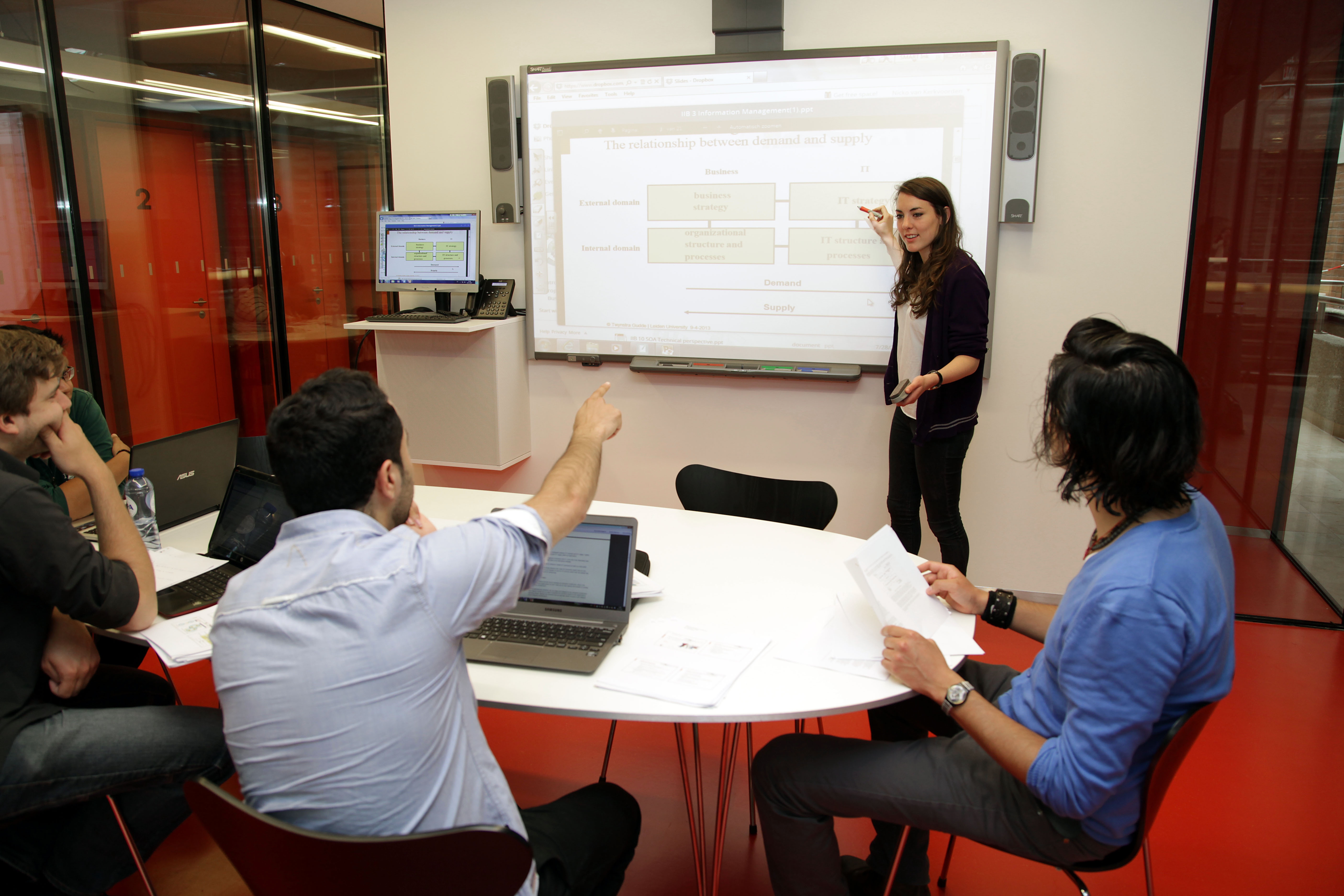
Image alt text: Student sharing during study group
Author credit: By Libr, CC BY 3.0 <https://creativecommons.org/licenses/by/3.0>, via Wikimedia Commons
Make a schedule for your exam day.
Ensure you have everything ready far before the exam; don't wait until the last minute to find you forgot what you were to bring. Check all the laws and criteria, then plan your route and travel time accordingly.
Consume lots of water.
When approaching test days, it is critical to bring enough water; remember that being hydrated is crucial for your brain to function optimally. Drink lots of water during your study period and on exam day.
What are the many types of tests?
Exams are part of everyday life, whether in school or at work. You must take a test now and again, and there are several sorts of tests and examinations with various goals:
Perform a diagnostic.
You may use this exam to see how much your pupils already know about a subject or topic. You can use the results of these assessments to arrange your lesson and discover which issues require particular attention. Furthermore, these examinations might reveal whether sections of the class require additional study time.
Performance evaluations.
Progress or accomplishment exams assess a learner's progress in a particular topic. You can better understand your pupils' development if you require them to take the assessments frequently. These tests follow after a diagnostic test.
Test of aptitude.
Learning institutions frequently perform placement exams to place students in a suitable class or level. Instructors often use these examinations before the commencement of language lessons.
Objective tests.
Objective tests feature distinct correct and incorrect responses. This category includes all multiple-choice assessments. Students take a pre-defined list of responses to select the right answer.
Subjective evaluations.
With these types of tests, the producer of the exam has to give judgment on the answers of the student. This is usually in the form of free-text questions or essays.
What are the many sorts of questions you can encounter on an exam?
Tests and exams are regular assessment and evaluation tools in educational institutions and often take the form of questions. Let's take a look at some of the questions you could encounter:
Multiple choice questions.
Numerous choice questions consist of one question and multiple alternative responses, including the correct answer and various erroneous answers. Students pick the right answer by circling or filling in the relevant circle on the machine-readable response sheet.
True or false questions.
True or false questions consist of only one assertion. Students answer questions by marking whether a statement is true or untrue. True or false questions, for example, have only two viable answers: true or false.
Examiners typically utilize true or false questions to measure the familiarity with course material and to look for common misunderstandings. Examiners typically operate these questions to allow students to react fast, causing them to be used in considerable numbers to evaluate knowledge of a wide range of topics.
Although most examiners prefer them since they are simple and quick to mark, they are time-consuming to design. Furthermore, they give pupils a 50% probability of getting the correct answer.

Image alt text: An Illustration of True of False Questioning for Gauging Student knowledge of Various Topics.
Author credit: By Kurt Kaiser, CC0, via Wikimedia Commons
https://upload.wikimedia.org/wikipedia/commons/4/42/True_or_false_graphic.png
Short answers questions.
Short answer questions generally consist of a quick prompt followed by a written response ranging from one or two words to a few lines. Examiners usually respond quickly to evaluate basic knowledge of crucial facts and phrases.
Furthermore, examiners can employ to assess higher thinking abilities such as analysis and assessment. Compared to multiple choice questions, most teachers remark that they are simple to create. Short-answer questions also provide learners more freedom to articulate their understanding and display creativity than multiple-choice questions.
Matching questions.
Students reply to matching questions by matching each set of stems with one of the test choices. Examiners frequently utilize these questions to measure recognition and recall and are most commonly employed in courses where acquiring specific information is an important goal.
They are often quick and straightforward to construct and mark, but students take longer to reply to these questions than a similar amount of multiple choice or true/false items.
Essays questions.
Essay questions present a complicated challenge that requires written replies ranging in length from a few paragraphs to many pages. Like short-response questions, they allow students to clarify their comprehension and display inventiveness, but they make it difficult for pupils to arrive at an acceptable answer by bluffing.
Instructors can build them quickly; marking these questions can be time-consuming and challenging to get a grader consensus. This openness allows students to exhibit their ability to integrate course information in novel ways. As a result, essays are a popular method for testing higher levels of cognition, such as analysis, synthesis, and assessment.
However, students sometimes take longer to write a five-paragraph essay than they would write five one-paragraph responses to short-answer questions. Because of the increasing workload, the number of essay questions you may present on a single test is limited, limiting the total breadth of an exam to a few themes or sectors.
Computational issues.
Computational questions necessitate students to perform computations to get an answer. Examiners can use computational questions to examine students' recollection of solution approaches and their ability to use those techniques to answer both previous problems.
Practical computational problems should be solved by understanding the course's significant ideas and methodologies. Before the exam, solve them yourself or ask a teaching aide. Furthermore, you should indicate a mark breakdown to reinforce the expectations created in in-class examples for the amount of information necessary for the answer.
Oral exams.
Students can answer the instructor's questions and submit prepared comments during oral exams. These tests are widespread in language courses that require speaking. Still, you may use them to measure understanding in practically any course if you follow the standards for constructing short answer questions.
Oral examinations are necessary because the response provides immediate feedback and allows pupils to learn while being assessed. However, there is the issue of record keeping and the required time. Furthermore, unlike writing tests, oral exams do not establish a written record automatically.
What are the rules for taking an exam at colleges and universities?
Here are some exam regulations put in place by universities and colleges to help examinees throughout the examination period:
Attendance.
Attendance at all University closed tests is required. Anybody who fails to take an exam at the time and location specified in the exam schedule will consider you to have forgotten that portion of the assessment. As a result, examinees must double-check their timetable and verify they are working with the most recent version.
Suppose a learner cannot attend an examination due to sickness or other compassionate circumstances. In that case, you must provide a medical certificate or a comprehensive report of any extraordinary event impacting assessment to the relevant board of studies. Before the committee evaluates the evaluation findings, you need to submit the completed information.
Identity.
Universities and colleges utilize the university card and exam candidate number to identify students taking an exam until the completion of the exam. Every response sheet in every exam requires students to submit their identity card numbers.
As an examinee, you must bring your university card as identification during the test and bring it to each exam. Throughout the exam, you must keep your card on the desk with the photograph facing up. Remember that failure to obtain the card indicates a failure to follow exam regulations on your behalf.
Behavior.
Following invigilator instructions during an exam is critical, and failing to do so is considered academic misconduct. For example, after taking your seat, you will be required to complete the ID slip and data on the front cover of the answer booklet.
Other behaviors, such as putting comments on the cover of a question paper or answer booklet, are considered academic dishonesty and will result in disciplinary action.
Talking to anybody other than an invigilator during a test is also considered academic misconduct. Also, on the invigilation team's direction, you must cease writing immediately after the test. As a result, during an exam, you must speak with only an invigilator.
Academic dishonesty.
Higher education institutions take academic misconduct very seriously since students are not permitted to cheat, conspire, fabricate, personate, or plagiarism of work. The examination board forbids students from bringing written, printed, or electronic materials or equipment inside the examination room.
Furthermore, as the examinee, you are not permitted to carry any gadget capable of storing or displaying data, including smartwatches and smartphones. Failure to keep these objects out of reach is an act of academic dishonesty, regardless of whether you use the device during the exam.
Materials for the examination.
The examination board always reminds pupils to take only examination materials in the test room. Some educational institutions may give answer books, statistics tables, data books, and calculators, all of the educational institution's property.
If exam applicants remove such documents on purpose is theft. Exam applicants are not permitted to write in objects such as statistics tables and data books, which are solely supplied for reference reasons during the examination.
What are the tips your students need to know when taking an exam?
Exams and exams cause a lot of tension and worry, which causes students to panic when they have to take an exam. However, as a student, you do not require novel test-taking tactics. Here are some tactics for taking an exam consider:
Read the instructions thoroughly.
The most straightforward apparent test-taking strategy is to read the instructions. Exam directions are there to help you to understand what you need to do. Unfortunately, most students rush directly into the passage and issue without first reading the recommendations.
It is critical to read all test guidelines to succeed by comprehending the exam requirements. As a result, as a teacher, demonstrate to your students how to understand directions by highlighting relevant terms.
Examine the questions thoroughly.
It would help if you studied your questions attentively when writing your paper. You can begin by looking through all the questions without answering them to identify whether they are challenging or straightforward; this will also help you determine how much time you will devote to each period.
After that, decide whatever question you want to answer and start with the easiest. Handling simple queries can boost your confidence early on.
Examine the timetable and stick to the deadline.
After determining how much time you will devote to each question, split your time accordingly. You must watch the clock; if you start falling behind, you must speed up your time to catch up.
If you become stuck, continue to the next question.
Another tip for taking an exam is to move on to another topic if you get stuck on one. This is especially important when dealing with science or mathematics courses requiring several computations.
In such a case, move on to the next question and return to the one with difficulty later. Despite earning more points for answering more questions, there is a good chance that when you return to it, you will discover that you can answer the questions after all.
When finished, please review the answers and double-check that they're accurate.
Finally, once you've completed your paper, you should have at least a few minutes to review and double-check your answers. This is undoubtedly worth completing to ensure no glaring flaws in your writing, grammar, or flow.
How do you respond to various types of questions?
First and foremost, as an examinee, you must grasp the questions you are dealing with since the type of response you will provide depends on the kind of question.
Understanding the various test questions will help you activate proper techniques for generating responses and lessen exam anxiety. Here are some ways to deal with multiple types of questions:
Problem-solving exams.
When taking an exam, especially a problem-based one, you must grasp the problem to discern what you intend to find. Consider producing a sketch or having an excellent explanation of the situation to get the best solution.
Later, follow the technique you created by ensuring tidy work free of errors for the examiner's solution to the problem. Finally, review your responses to determine whether they are reasonable; if not, you must redesign the problem.
Exams with multiple choice answers.
When taking an exam on multiple-choice, read the stem and ensure you comprehend what it is trying to say before coming up with the proper answer. To assist you in ruling out alternatives similar to the correct answer, try to come up with appropriate responses by evaluating all possibilities.
Remove any settings that you know are inaccurate. This will allow you to concentrate on the remaining options and avoid the possibility of returning an item and selecting an option you have previously rejected. After that, go through the information you need clarification on to see which one is accurate.
Essay exams.
Practice composing essays by anticipating the questions when taking an exam with essay questions. Make an overview of potential essay subjects using your course materials, so you know you understand what may be on the test, then reproduce your outlines from memory.
Later on, practice writing at least one entire essay while keeping track of the time you spend preparing and considering how much time you will have throughout the test to assist you during the actual writing.
Conclusion.
Students must follow the advice above, especially when studying for an exam or a test, to be the best in their class. Ensure you understand every direction to apply them effectively in your forthcoming tests.
Contributor: admin
